Fair Transitions for Swedish Citizenship
Sweden's new citizenship law lacks transition provisions for those who already applied. We're working to ensure applications are assessed under the rules in place at the time of submission.

Sweden's new citizenship law lacks transition provisions for those who already applied. We're working to ensure applications are assessed under the rules in place at the time of submission.

The Swedish government announced that citizenship requirements will change on June 6, 2026. Critically, no transition provisions were included for pending applications — meaning people who applied years ago under different rules will now be assessed under the new criteria.
People who moved to Sweden, built careers, paid taxes, learned the language, and applied for citizenship in good faith under the existing rules now face dramatically different requirements from those they originally agreed to.


A transition clause — or transition provision — would allow people who applied under the old rules to be evaluated under those same rules. This is standard legal practice when laws change.
We're not asking for special treatment. We're asking for the same principle of fairness that is applied in legal systems around the world: that applications submitted before June 6, 2026 should be assessed under the rules that existed at the time of application.
Our goal is to explore legal avenues — including EU law precedents, Swedish constitutional principles, and administrative law remedies — to protect the commitments that were made under existing rules.


The official government inquiry into Swedish citizenship — Skärpta krav för svenskt medborgarskap (SOU 2025:1) — was prepared by legal experts and judges with extensive administrative law experience. It set out comprehensive proposals for new criteria, including extended residency requirements.
The inquiry explicitly recommended that pending applications be assessed under the rules in place at the time of submission — citing fairness, legal certainty, predictability, and equal treatment. The government chose not to follow this recommendation and omitted transition provisions entirely.
Read the inquiry report — SOU 2025:1 "Skärpta krav för svenskt medborgarskap"

On February 20, 2026, Lagrådet — Sweden's independent body of senior judges that reviews the legal quality of proposed legislation — issued its opinion on the proposed citizenship reform.
"Lagrådet anser att det är olämpligt att införa den föreslagna regleringen utan övergångsbestämmelser. Lagrådet avråder därför från en sådan ordning."
In its reasoning, Lagrådet highlights legal certainty (rättssäkerhet), predictability, equal treatment, and the legitimate expectations of applicants who applied under the previous legal framework.
Read Lagrådet's full opinion
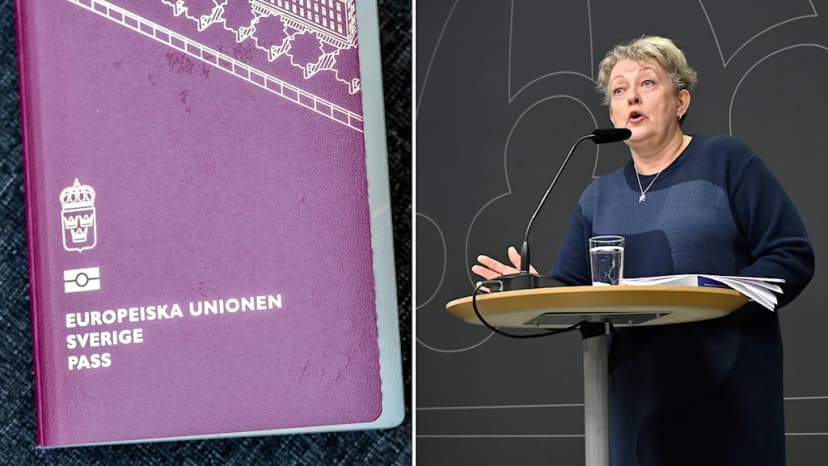
“It is in the interest of the rule of law and a sense of fairness that what you apply for is tried according to the rules that are in place at the time of application.”
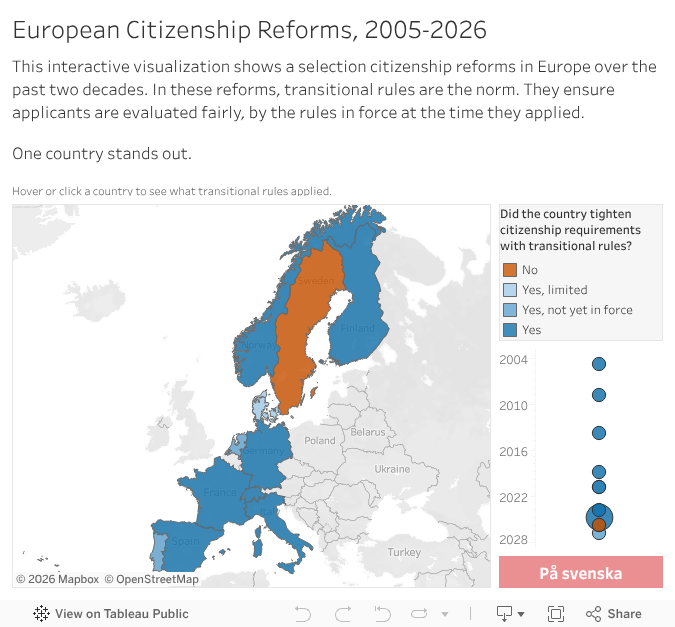
Explore how European countries have handled citizenship reforms between 2005 and 2026. Sweden stands alone in proposing no transition provisions for pending applications.
Real voices from people affected by the new citizenship law changes.
“I am done with Sweden. I planned a long-term life here based on citizenship and now I see all my plans ruined. I am tired of the Migration Agency deciding on my destiny. I want to live in a place that I am not afraid of the government changing the rules all the time.”
— Ricardo
Software developer, Stockholm
“The Swedish government has lost its trustworthiness. If I had known that the rules and laws were so unstable, I wouldn't have moved here. Highly skilled labor is attracted to stability and economic incentive. Neither of them exist in this country now.”
— Jake
Software developer, Uppsala
“The retroactive application of new rules is unfair and unjust. When people envisage and build a life overseas that they uproot partners, sell houses and plan around particular timelines, moving the goalposts can be dramatically impactful.”
— Craig
Tech worker, Stockholm
“I find it deeply unfair to apply the law retrospectively, especially given the already extreme waiting times.”
— Dmitri
Product owner, Malmö
“The retroactive application of rules depict a fundamental logical and ethical failure here. The state is using its own administrative inefficiency to disqualify people who met every single requirement at the time of their application. How can a country that prides itself on rättssäkerhet (legal certainty) justify changing the rules of the game?”
— Hassan
PhD in Computer Science, Uppsala
“I've waited and I've followed the right processes and I feel like I've done everything right, and then to find out I'm playing a different game all of a sudden feels a bit unfair.”
— Tom
Citizenship applicant, Malmö
Friends, high-skilled workers, spouses, colleagues, and neighbors are now caught in legal limbo. Every person with a pending citizenship application may be impacted, with no clear transition plan for those who already applied in good faith.
Fair Transition Sweden is a grassroots initiative advocating for a transition clause in Sweden's new citizenship law.
"It is in the interest of the rule of law and a sense of fairness that what you apply for is tried according to the rules that are in place at the time of application,"
said Kirsi Laakso Utvik, the author of the government inquiry into the citizenship reforms. The inquiry concluded that applications submitted before the new law takes effect should be assessed under the previous legislation. However, this recommendation was not adopted.
We fully respect Sweden's right to update its citizenship policy going forward. Our request is narrow and practical: people who already submitted applications should be assessed under the rules that existed at the time they applied.
Many residents with pending citizenship applications are now affected by the lack of transition provisions. Many applicants had already met the previous requirements, but because their cases remain in processing, they may now face new criteria when the law takes effect on June 6.
We call on policymakers to introduce a transition clause so pending applications are assessed under the previous rules. This allows reform to move forward while preserving legal certainty for those already in the system. It is a balanced, lawful solution that honors good-faith applications and strengthens trust in public institutions.
Share these images on social media to help spread awareness about the need for a transition clause in Sweden's new citizenship law.
Join the WhatsApp working group to share your experience, stay informed, and coordinate with others in the same situation.
Join WhatsApp Group →If you have expertise in Swedish administrative law, EU law, or constitutional law, your guidance could make a real difference.
Get In Touch →Even if you're not directly affected, you can help by sharing this page, contacting elected officials, or amplifying affected voices.
No. We respect Sweden's right to update its citizenship policy going forward. Our focus is on fairness for people who already applied under earlier rules. We are advocating for a transition clause so pending applications can be assessed under the requirements that existed at the time of application.
Transition clauses are standard legal practice when laws change. They protect legal certainty and ensure that people who acted in good faith are not disadvantaged when new rules take effect. Swedish legal experts in the official government inquiry (SOU 2025:1) explicitly recommended transition provisions for pending applications, citing principles of fairness, predictability, and equal treatment. The government chose to disregard those recommendations. Without a transition provision, long-term residents face new requirements years after submitting their applications.
No. Fair Transition Sweden is a non-partisan, grassroots initiative created by affected residents. Our goal is to promote legal consistency and fairness, not to support any political party or agenda.
Anyone with a pending Swedish citizenship application submitted before June 6, 2026 may be affected. This includes people who already met the previous requirements but are still waiting for a decision.
We are a group of residents directly affected by the lack of transition provisions in the new citizenship law, along with supporters who care about fairness and legal certainty. This is a volunteer-led, non-commercial initiative.
Radio Sweden — Sveriges Radio
Media coverage of Sweden's new citizenship law and the need for transition provisions.


